
Isabella was not the mother the three tiger cubs were born to, but she became the mother they suddenly needed.
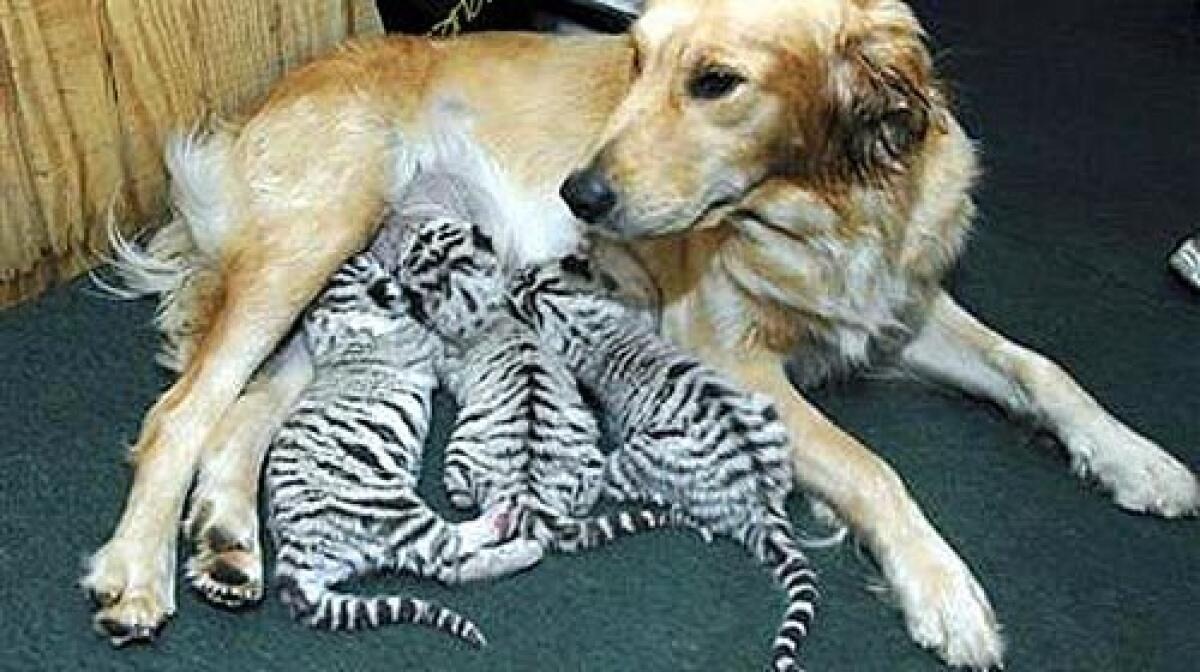
At Safari Zoological Park near Caney, Kansas, three white tiger cubs were born into a dangerous first week of life. Their biological mother had problems with them from the beginning, according to park owner Tom Harvey. By the next day, she had stopped caring for them. For newborn cubs, that kind of rejection is not a small complication. It can quickly become a matter of survival. They were too young to fend for themselves, too fragile to wait, and completely dependent on someone stepping in.
Harvey told the Los Angeles Times that the cubs were wandering around, trying to find their birth mother, but she would not pay attention to them. That image is the emotional center of the story: tiny white tiger cubs, only days old, searching for the mother whose body they instinctively needed, while the adults around them realized the situation was not going to fix itself.
The park had to make a decision quickly.
That is when the cubs were put in the care of Isabella, a golden retriever who had recently weaned her own puppies. Isabella was not a tiger, and the cubs were not dogs, but the timing worked in a way that felt almost impossible. Puppies and tiger cubs develop on a similar early timeline, and Isabella’s own maternal period had just ended. Her body and instincts were still close enough to motherhood that she could accept babies who were not her own.
Harvey said the timing “couldn’t have been any better.”
What happened next is the part people remembered for years. Isabella accepted the cubs. She let them nurse. She licked them, cleaned them, fed them and treated them with the calm patience of a mother caring for babies. The cubs did not know that she was the wrong species. Isabella did not seem bothered that they were striped, wild animals who would one day grow far larger than she was. In that moment, they were simply small, hungry babies, and she responded to them the way a mother responds.
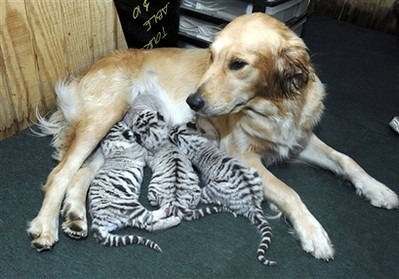
A photo from the Daily Reporter, later circulated by the Associated Press and used by the Los Angeles Times, shows Isabella lying with the three white tiger cubs pressed close to her body. It is not a dramatic rescue image in the usual sense. There are no cages in the foreground, no mud, no obvious injury. But the story behind the picture is quietly powerful. Those cubs were alive and nursing because a dog stepped into a space their own mother had left empty.
Harvey explained that dogs caring for tiger cubs is unusual, but not unheard of. He had seen reports of pigs nursing cubs in China, and he had actually gotten Isabella after his wife saw television accounts of dogs caring for tiger cubs. That detail makes Isabella’s role feel less like a random accident and more like a possibility the park knew might one day matter. Still, knowing such things can happen is different from watching a specific dog accept three specific cubs who need her immediately.
For the cubs, Isabella’s care provided more than food. Newborn animals need warmth, cleaning and stimulation. They need the repeated contact that tells their bodies to keep functioning. A mother’s licking and attention are part of early survival. When Isabella licked and cleaned the cubs, she was not just being affectionate. She was providing the basic care their birth mother was not giving them.
The cubs were part of Safari Zoological Park, a licensed facility open since 1989 that specialized in endangered species. At the time, the park housed leopards, lions, cougars, baboons, ring-tailed lemurs, bears and other animals. It also had several white tigers and orange tigers. The Los Angeles Times noted an important point about white tigers: because they are inbred from the first known specimen found more than half a century earlier, they are not as genetically stable as orange tigers. That background gives the cubs’ survival another layer. They were not just visually rare babies; they were fragile newborns from a line already known for genetic concerns.
Later coverage identified the three Bengal tiger cubs as Nasira, Anjika and Sidani. A Snuggle Upworthy summary, citing Today, reported that the cubs eventually outgrew Isabella dramatically, reaching around 140 pounds. Harvey reportedly referred to them as “tiger teens.” At that stage, they were still playful around Isabella, but too large to be left with her unsupervised. That is the natural limit of a cross-species adoption story. A golden retriever can save a tiger cub’s earliest days, but she cannot safely mother full-grown young tigers the way she could nurse newborns.
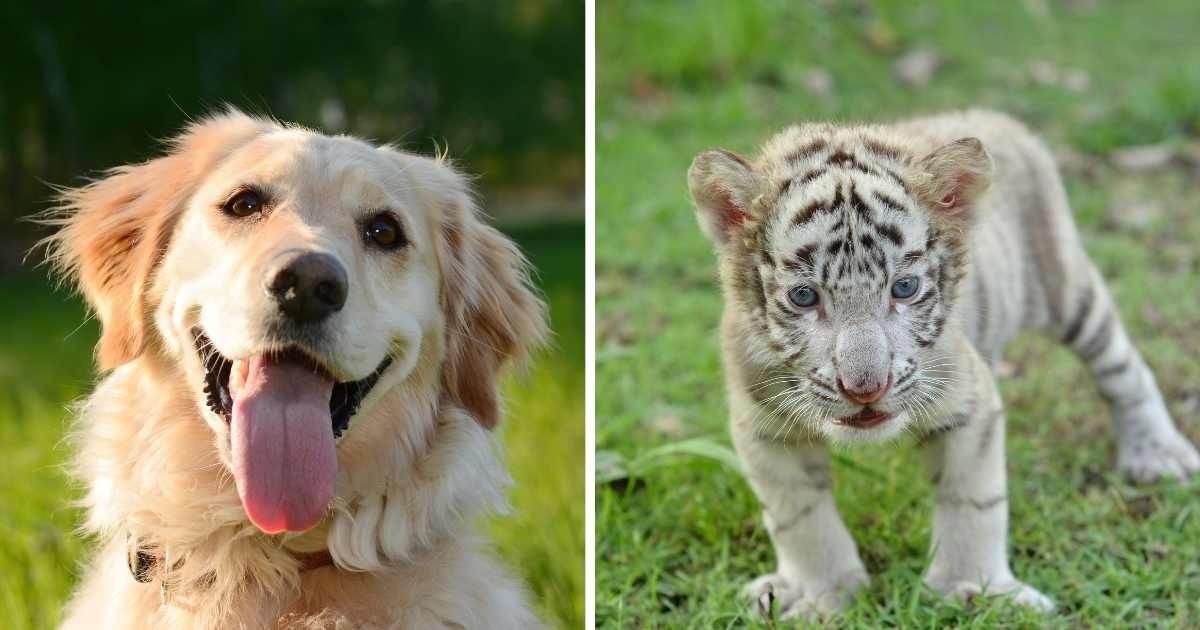
Even so, the bond did not disappear the moment the cubs grew. The later report described Isabella, also called Izzy, as supervising while the young tigers played more with Sandy, Isabella’s puppy, whom they seemed to treat like a sister. That part of the story is less useful as a dramatic rescue scene, but it shows that the early family arrangement left an imprint. The cubs were not simply fed and forgotten. They grew up with a dog and her puppy as part of their earliest social world.
Researchers and animal behavior experts have offered explanations for why dogs sometimes accept babies from another species. The simplest explanation is that young mammals carry cues that can trigger nurturing behavior in other mammals, especially in females who have recently mothered their own young. Scent, sound, size and need all matter. A newborn animal does not have to look exactly like a puppy to activate a caregiving response in a receptive dog. Isabella’s response may have been unusual, but it was rooted in a very old biological instinct: protect the young thing that needs care.
For a PupWeekly-style article, Isabella’s story is different from a typical abandoned-dog rescue. Isabella was not the animal in danger. She was the rescuer. The abandoned babies were tiger cubs, not puppies. That means the story should not be framed as a sad dog rescue or used with a false crisis caption about Isabella herself. The honest emotional angle is that a golden retriever became a mother to three newborns after their own mother stopped caring for them.
The image supply is also limited. The real, source-supported photo is the LA Times/AP image of Isabella nursing the cubs. A Flickr page reposts the same AP/Daily Reporter photo with a detailed caption identifying Isabella, the Safari Zoological Park, Caney, Kansas, and the July 30, 2008 date. Other modern pages include representative tiger and dog images, but those are not confirmed to show Isabella or her cubs. They should not be used as if they are same-animal originals.
That limitation does not kill the story, but it does define how it should be packaged. It is a strong “amazing animal mother” article, not a high-pathos rescue-dog slot. The safest version uses the real LA Times/AP image as the featured image, clearly tells readers that Isabella adopted the cubs after their mother rejected them, and avoids pretending there are multiple original same-scene photos if the only reliable photo is the one AP image.
Isabella’s story works because it is simple and emotionally clean. Three babies were abandoned at the moment they most needed a mother. A golden retriever who had just finished raising her own puppies accepted them. She fed them, cleaned them and gave them the first chance their birth mother could not.
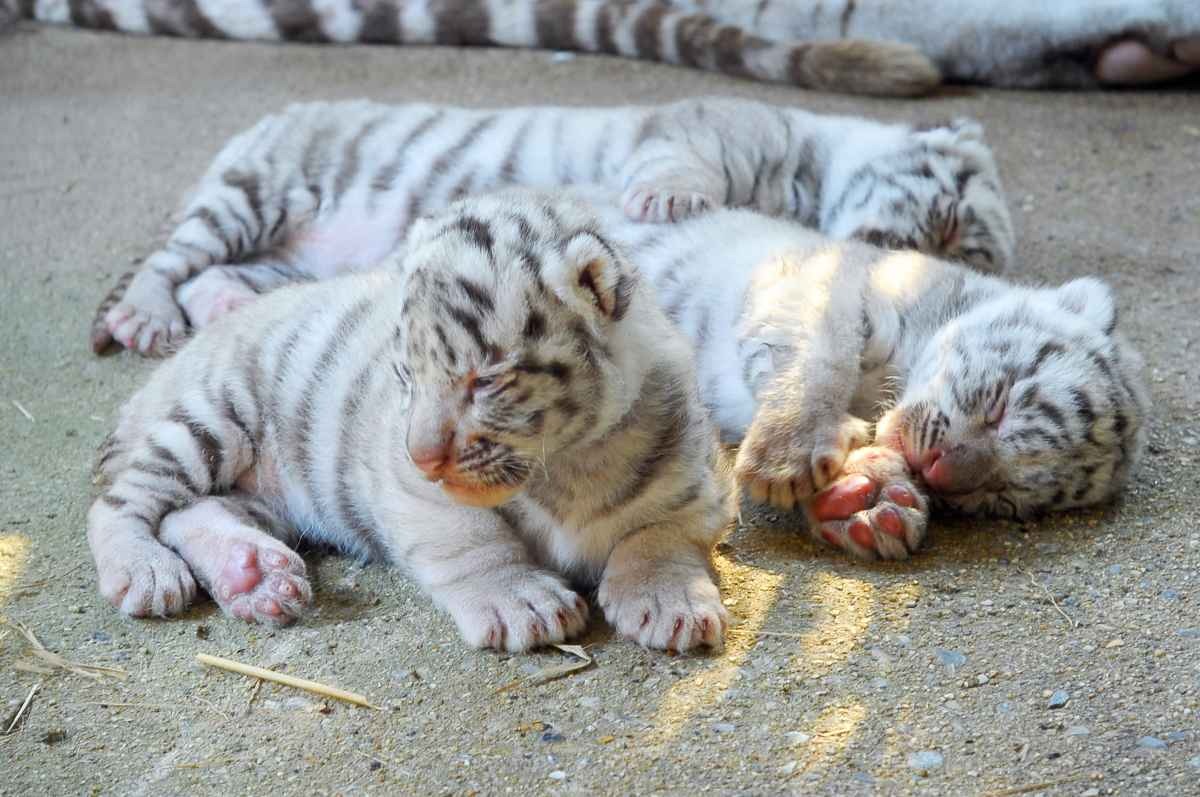
The cubs would grow into animals far bigger and stronger than the dog who once nursed them. But at the beginning, before they were “tiger teens,” before their names became part of a strange and sweet animal story, they were just newborns searching for warmth. Isabella gave them that warmth when it mattered most.
Source: Original reporting