
The call came from someone who could no longer look away.
A large dog was living in unsafe conditions near Lucky Dawg Animal Rescue in Avondale, Pennsylvania.
The dog was only about a mile from the rescue, yet his lonely world had remained hidden in plain sight.
Also readDog With a Missing Ear Starts a New Life With His Forever Dad
Mary C. Bauer, president of Lucky Dawg Animal Rescue, has spent years answering calls about animals who need help.
Her organization is run by volunteers and foster families who open their homes to dogs with nowhere else to go.
When Mary heard about this dog, she did what she had done so many times before.
She went straight to him.
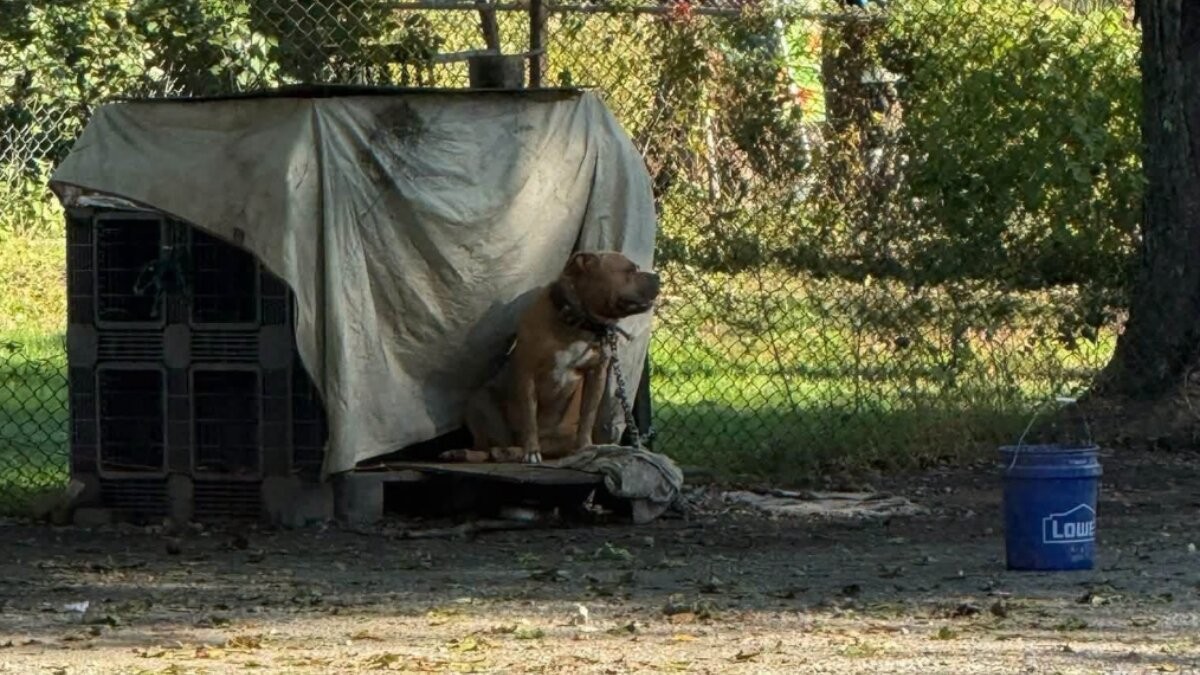
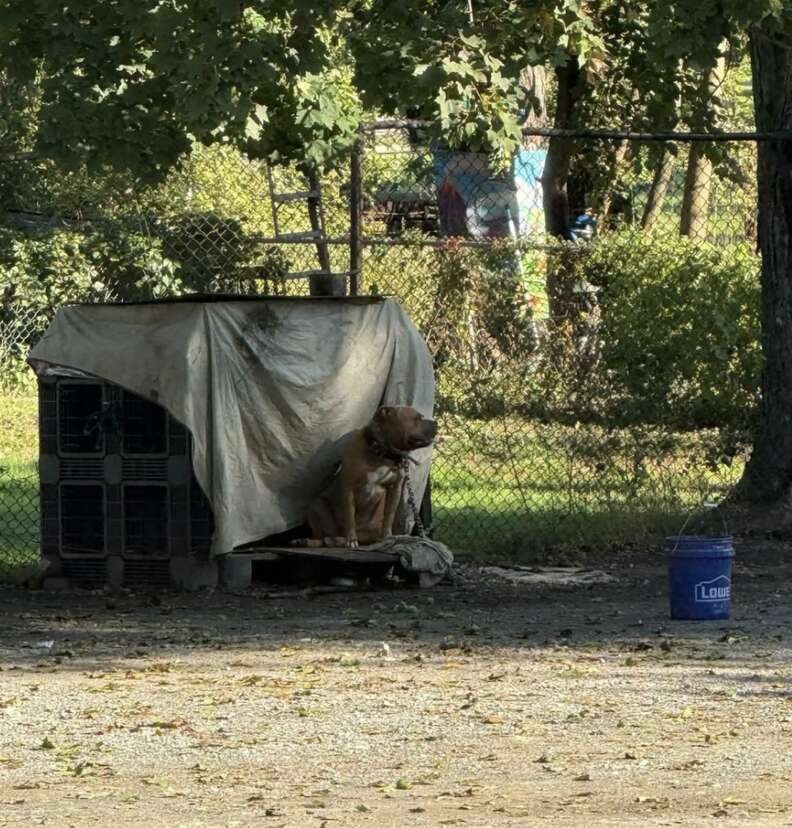
What she found was a large pup tied outside by a thick chain that measured only four feet long.
The chain was so heavy and short that the dog could not fully enter the makeshift shelter meant to protect him.
His water bowl held no clean water.
There was only mud.
For a dog his size, four feet gave him almost no room to walk, stretch, explore, or choose where to rest.
His life had been reduced to a tiny circle in the dirt.
Local people said he had lived that way for more than a year.
Concerned neighbors sometimes brought him food and water, giving him small moments of care in a place where comfort was scarce.
Still, no friendly hand could make that chain feel lighter.
His whole world ended where the metal stopped.
Mary slowly moved closer, unsure how the dog might respond.
A frightened dog can bark, hide, freeze, or pull away because fear is sometimes the only protection he has left.
Mary expected to see that fear in his face.
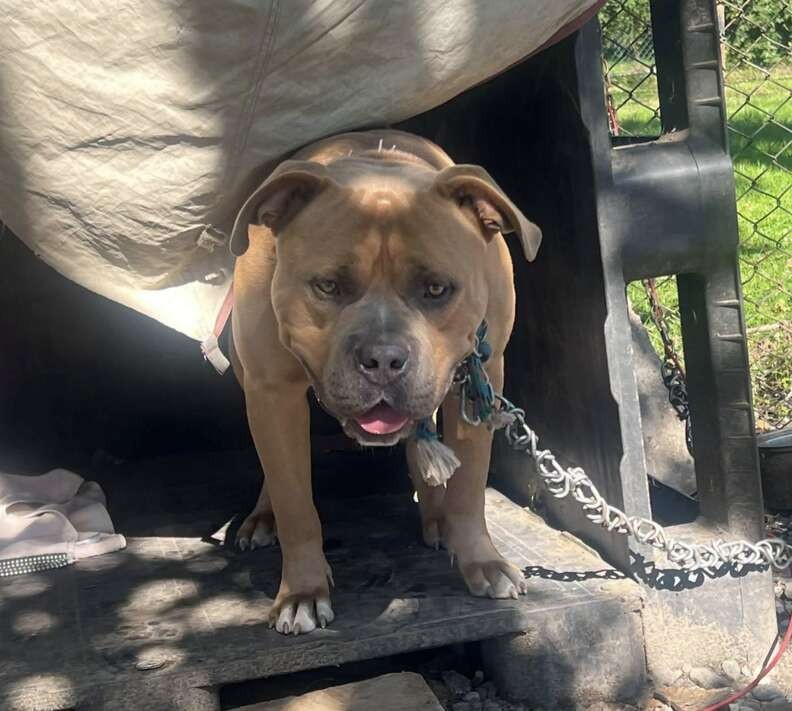
Instead, his tail began to wag.
The large dog watched her with deep, soulful eyes and gently accepted treats from her hand.
There was no angry charge and no warning growl.
There was only a tired dog choosing to trust a stranger.
Mary would later describe him as a “gentle giant.”
That gentle spirit made the sight of his chain even more painful.
He had been left without the basic freedom to move, yet he still greeted kindness with kindness.
Mary felt heartbreak as she looked at him.
She also felt anger.
Most of all, she felt determined to change what was happening.
Boyer had not given up on people.
Mary could not simply remove him without permission, so she began working on a safe and lawful way to secure his release.
Later that day, she returned with another rescue volunteer and a police officer.
The dog was still there, attached to the same short stretch of metal.
Mary and the others negotiated for his release, knowing that his future depended on what happened next.
They stayed focused on the dog waiting beside them.
At last, an agreement was reached.
The chain could come off.
For more than a year, according to neighbors, that chain had controlled where he slept, where he stood, and how far he could move.
Now rescuers brought out the tools needed to cut it.
The metal finally broke apart.
The dog who had lived at the end of four feet of chain was free.
His rescuers named him Boyer.
He did not have to understand every word being spoken around him to know that something had changed.
Hands were reaching toward him with care instead of leaving him alone.
People were guiding him toward a car instead of walking away.
There would be no more pulling against a chain just to reach the shelter behind him.
For the first time in a long time, Boyer could move forward.
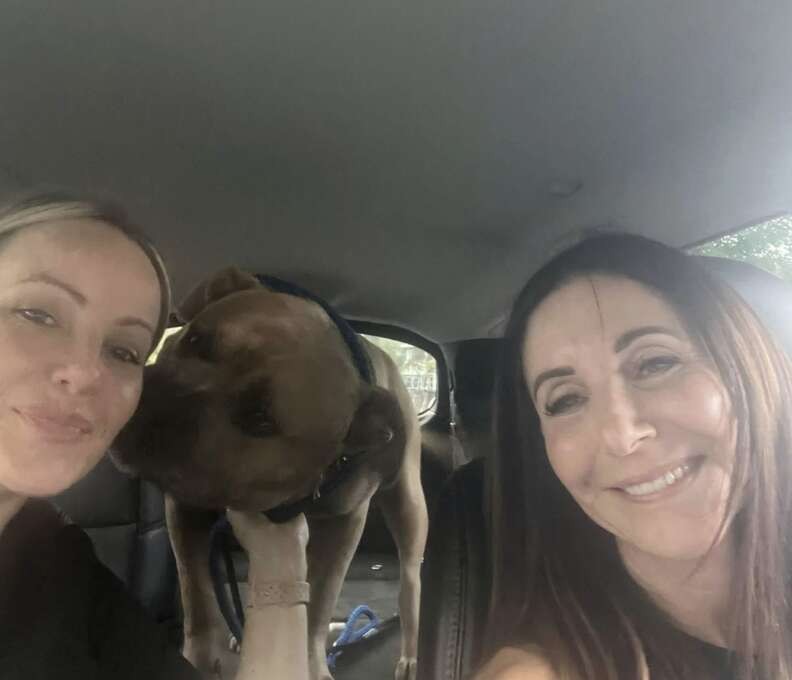
The volunteers helped him into the vehicle for the short ride to the rescue.
A dog who had every reason to fear people responded in the most tender way he knew.
He gave his rescuers sloppy kisses.
Those kisses filled the car with relief.
They also revealed something important about the dog beneath the neglect.
Boyer was not defined by the chain around his neck.
He was affectionate, openhearted, and ready to be near people.
His rescuers had arrived prepared to help a frightened animal.
Instead, their gentle giant seemed eager to comfort them, too.
Perhaps he sensed their soft voices and careful hands.
Perhaps he simply knew that the weight holding him back was gone.
Whatever he understood in that moment, his kisses said enough.
He was still capable of joy.
He was still willing to love.
At Lucky Dawg Animal Rescue, Boyer’s days began to look very different.
His bowl was no longer filled with mud.
He received big dinners and fresh water.
Soft blankets gave him a place to settle his large body.
Open space replaced the cramped circle where he had spent so much time.
Boyer could run through the rescue’s field with no chain deciding when he had to stop.
Every stride carried him farther than four feet.
Every free step gave his rescuers another glimpse of the life he should have had all along.
The heavy chain was gone, but healing would take time.
Dogs who experience neglect do not always leave the past behind the moment they reach safety.
Their bodies may relax before their minds understand that danger has ended.
New rooms, sounds, people, and routines can all feel strange.
Boyer needed time to rest and show his rescuers what made him feel secure.
No one at Lucky Dawg wanted to rush him.
They planned to learn about his needs before deciding when he would be ready for adoption.
For now, the important things were simple.
He had food.
He had blankets.
He had room to move.
Most of all, he had people watching over him.
The same dog who once could not fully enter his shelter could now choose where he wanted to lie down.
That choice might seem small to us.
For Boyer, it was part of getting his life back.
His rescuers could watch him run and know that no metal would snap him to a stop.
They could see him eat and know he would not have to wait for a concerned neighbor to notice an empty bowl.
They could tuck blankets around him and know he was finally surrounded by care.
Safety was becoming something Boyer could feel.
Boyer’s rescue began because one community member paid attention.
Someone saw that a dog nearby was suffering and decided that silence was not good enough.
That one report reached Mary, who came to see the conditions for herself.
Then a volunteer and a police officer joined the effort.
Neighbors also helped fill in the painful truth about how long Boyer had lived on the chain.
Each person became part of the path that led him away from the mud and into safety.
Mary hopes his story reminds people to notice animals in their own neighborhoods.
Neglect does not always happen far away.
Sometimes it sits behind a nearby house or fence, close enough to be missed because people assume someone else will help.
A dog cannot make a phone call or explain that his bowl is empty.
He cannot tell anyone that his chain is too short for him to reach shelter.
He has to depend on a person who sees his pain and chooses to speak.
In Boyer’s case, that choice changed everything.
One phone call opened the door to his new life.
Boyer is not ready to be rushed into the next chapter.
The rescue will give him time to heal and learn more about the home that would fit him best.
When that time comes, they hope he will find a loving family of his own.
They picture a comfortable bed where his large body can stretch without touching cold ground.
They picture plenty of room for him to walk, play, and follow the people he loves.
They picture full bowls, gentle hands, and evenings when he can sleep without the pull of heavy metal.
Most of all, they picture a life in which Boyer never has to feel trapped again.
The past cannot be erased, but it no longer controls where he goes.
Now, when Boyer moves toward someone, it is because he chooses to.
When he gives a kiss, there is no chain pulling him back.
And when he runs across the open field, the gentle giant finally gets to discover just how wide his world can be.
 Mable Once Shook at Every Touch, but Patient Love Helped Her Feel Safe
 Trapped Beneath Thundering Hooves, But Waited for Someone to See Her
 Abandoned Beside A Park, Monkey Would Not Leave Her Little Stuffed Friend
 Ginger’s Last Day Out Became the First Day of Her New Life
 They Searched the Desert for One Dog, but Tiny Prince Needed Them Most
 A 2.4-Pound Puppy Climbed Toward Hope—and Saved His Whole Family